

At some point, most of us have been told to ‘calm down’. Perhaps less often in those exact words, more often in the form of advice.
Try to relax.
Take a breath.
Just don’t think about it.
If you’ve ever been on the receiving end of that ‘kindness’ while your nervous system was running at full pitch, you’ll know just how frustrating it can be.
Not because the person saying it was wrong, but quite simply because calm isn’t something you can just decide to have.
Calm isn’t an on-demand choice that’s available at the flick of a switch. In fact, it’s often the case that the more you try to reach for calm the more your nervous system digs in.
It’s important to recognise that calm and safe are not the same thing, they’re not even the same type of thing.
Calm is a state. Safe is a signal.
Calm is what our nervous systems look and feel like when they’re not on alert. It’s the output, the result. You can’t manufacture it directly any more than you can with tiredness by lying still and insisting you’re asleep!
Safe is something completely different. It’s what the nervous system is constantly scanning the environment (inner and outer) for and trying to assess in the background.
We’re not talking safe in an abstract sense such as in ‘is the world generally okay?’ Rather this type of safe is about the immediate, the physical, right-now sense.
“Is my body, in this moment, in this environment, okay?”
We’re rarely aware of this because, most of the time there’s nothing to report. But sometimes the scan brings up an uncertainty. It could be real and or it could be that our system has responded based on an old experience that triggers ‘danger’ in a situation that isn’t actually dangerous anymore.
However, once triggered it’s almost impossible to talk our nervous systems back down to a place of safety. It’s like, intellectually knowing my presentation will be fine, that my relationship is solid, that nothing terrible is about to happen today but somehow, I still feel my shallow breath, my tight chest, and the low-level alarm, that keeps me alert to the ‘danger’.
As we said in last week’s post, it’s certainly not irrational.
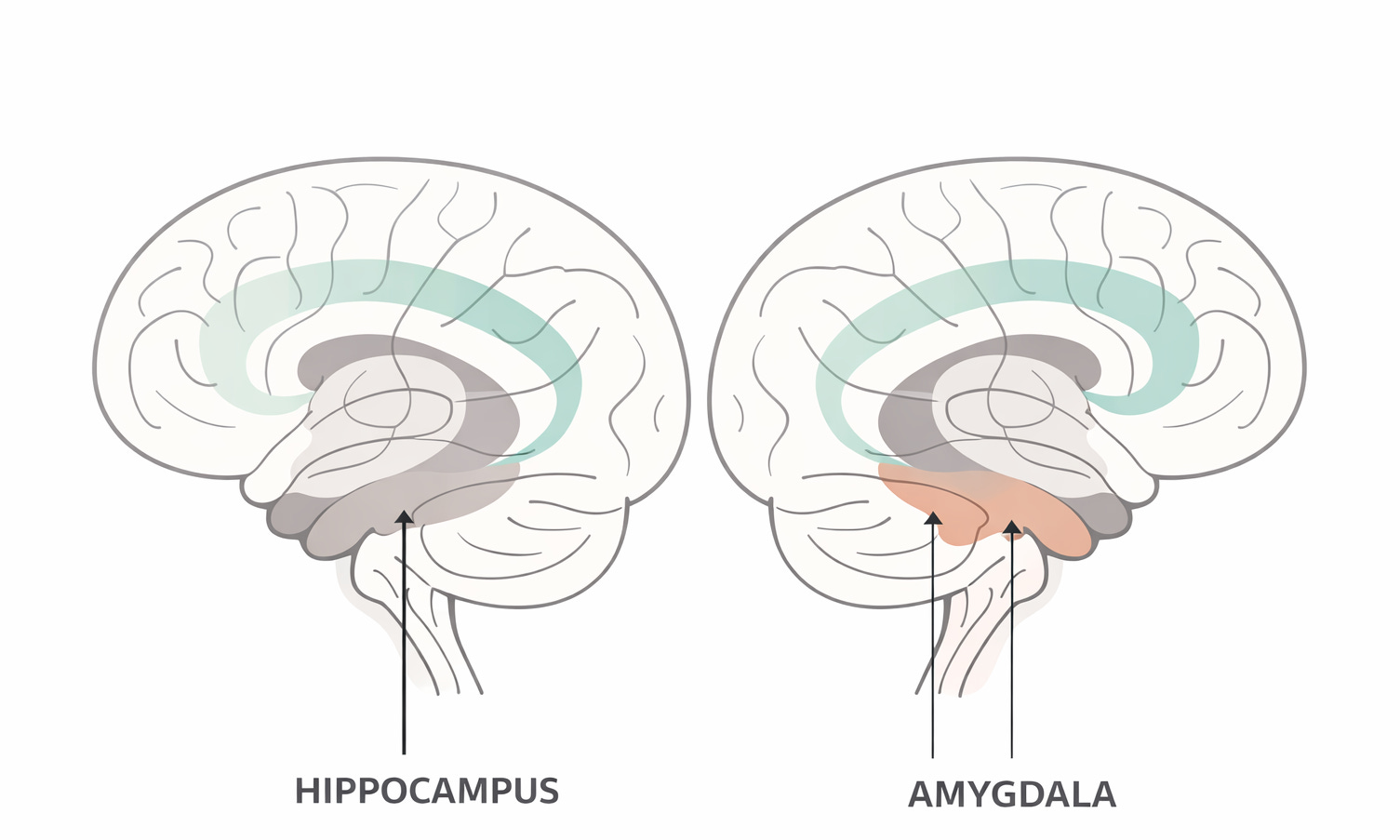
Basically, it’s the gap between our ‘primitive’ fight, flight or freeze centre that operates our threat detection system, and our more rational thinking brain. In fact, the amygdala (that ‘primitive’ point in the centre of the brain) receives information before our thinking brain. And as such the emotions are triggered before we can reasonably think about what just happened!
But here’s an important bit. We can actually take back control! We can send safety signals, small physical ones at first but as the nervous system receives enough of them, it will begin to update its assessment.
The nerve that connects everything
Let’s just take a closer look at what’s happening here.
The vagus nerve that runs from your brainstem all the way down your body connecting your heart, lungs, gut and other organs, plays a critical role in how your nervous systems shifts between states of alert and rest.
This process is a two-way channel. Through this nerve the brain sends information to the body, but equally the body also sends information up to the brain. It is the upward traffic that accounts for the majority of our inner communication. The vagus nerve then, is primarily providing bodily information about our heart rate, breath, gut state, muscle tension which is being sent up to the brain. So, the communication is less the verbal, worrying, narrative chatter and more about the physical hum underneath it.
Which means that what you do with your body has a direct impact on what your nervous system registers as true.
If your heart is racing and your shoulders are tensed up around your ears, your brain will act accordingly and vice versa.
So, small physical actions should be the first place to start to remedy this.
I’m sure we’ve all had those ‘in the head conversations’ that we’d rather not hear. And the more we try to still the chatter the louder it becomes. It is then, at this point, that we need to take physical action.
For example,
If you slow your exhale, the vagus nerve will carry that information upward. It’s received as data ‘Aha something has slowed down. Perhaps the threat has passed.’
You could hum quietly, which creates a vibration in your chest and throat, again a new message for the nervous system to ponder.
Put your feet flat on the floor and your nervous system gets a message of physical grounding, of weight, of contact, of presence in the now moment.
These aren’t tricks and they’re not wellness theatre.
They are inputs to a system that is genuinely able to listen and more importantly, to respond.
Why ‘performing’ calm makes things worse
There’s a particular kind of effort that goes into trying to seem calm when actually you’re not. The jaw held deliberately loose. The voice kept deliberately even. The breath that you’re consciously managing because you’re aware that it’s gone shallow.
The problem is that the effort of trying actually becomes a signal.
Occasionally if I’m finding it difficult to sleep, I listen to an audio and allow my jaw to loosen and my tongue to rest on the bottom of my mouth. And of course, the more I ‘try’ the more awake I feel!
I am working hard to lift something heavy, or I am working hard to suppress a feeling.
Effort is always read by our systems as activation. The very act of performing calm is, physiologically and it does the absolute opposite.
This is why when someone says, just relax it usually lands badly.
Relaxation can’t be a situation of ‘efforting’.
Cold water on your wrists is another good move. The sudden change in temperature gives your system something concrete to register, being present, physical, in the now.
Of course, these actions alone won’t dissolve a panic attack or resolve a genuinely threatening situation and that’s not really their purpose. The purpose is by doing something much smaller you are sending the nervous system enough data to begin to question whether full alert is still necessary.
What’s buried in all of this?
Here’s the thing that I found a little unsettling when I first encountered this.
If our nervous systems can be moved toward safety through small physical inputs, humming, breathing, cold water, ground contact, then does it follow that safety is something we can participate in. Not control, but rather influence.
And if that’s the case, then the question I ask is what have I (we) been doing instead?
My guess is that we’re really not so different. Most of us have spent years trying to think our way to calm. Trying to reason with the anxiety. Challenge our thoughts by asking whether our fear is proportionate. Enter more enhanced chatter!
These aren’t useless because our thinking brain has a role. But when the nervous system is activated, it’s not really a thinking problem. It’s often a body problem. And a body problem will need a body answer first.
It isn’t that we’ve been doing it wrong, the tools were always more accessible than we realised. We don’t need an app or a complicated breathing exercise we simply need to reach for the tools that are so much closer.
Our exhale. The floor under our feet. The hum which vibrates in our throat and chest. All of these present as data or signals to begin to soothe the nervous system.
What this looks like, practically
We don’t need to wait for a moment of crisis to practice any of this. In fact, the more we offer the nervous system these small safety signals in ordinary moments, the more accessible they become when we actually need them.
Before a difficult conversation, rather than rehearsing it in your head and therefore focusing on the chatter and effort, try two or three long exhales first. Let the out-breath run longer than the in-breath. You’re not trying to feel calm. You’re simply shifting the ratio.
When you notice the hum of anxiety, without any obvious source, try placing both feet flat on the floor and pressing them down gently. Notice the contact. That’s it. You’re not meditating. You’re just giving your nervous system different input to process.
None of these are cures. They are simply a few tools that are fully accessible to us when we need them.
A closing thought
Calm is not a performance. It’s not something the most stoic or the most zen among us have simply mastered through sheer willpower.
It’s actually what happens when we provide our nervous system with enough evidence that the danger has passed, or maybe that it was never quite as imminent as it seemed.
One exhale, one moment of contact with the floor, one small vibration in your chest, at a time. Your nervous system is definitely listening. It just doesn’t speak the language of thoughts.
Have a great soothing day
Kathy 😘
Thank you Kathy. Yes it’s all a matter of convincing your brain that nothing is wrong. If we really were in danger, we wouldn’t be breathing slowly and exhaling deeply. The more we tell ourselves we are okay, the more our brains believe it’s true. 💕