

On stress, signals, and learning to read the room you’re already in
There is a little white cat sitting at my window as I write this.
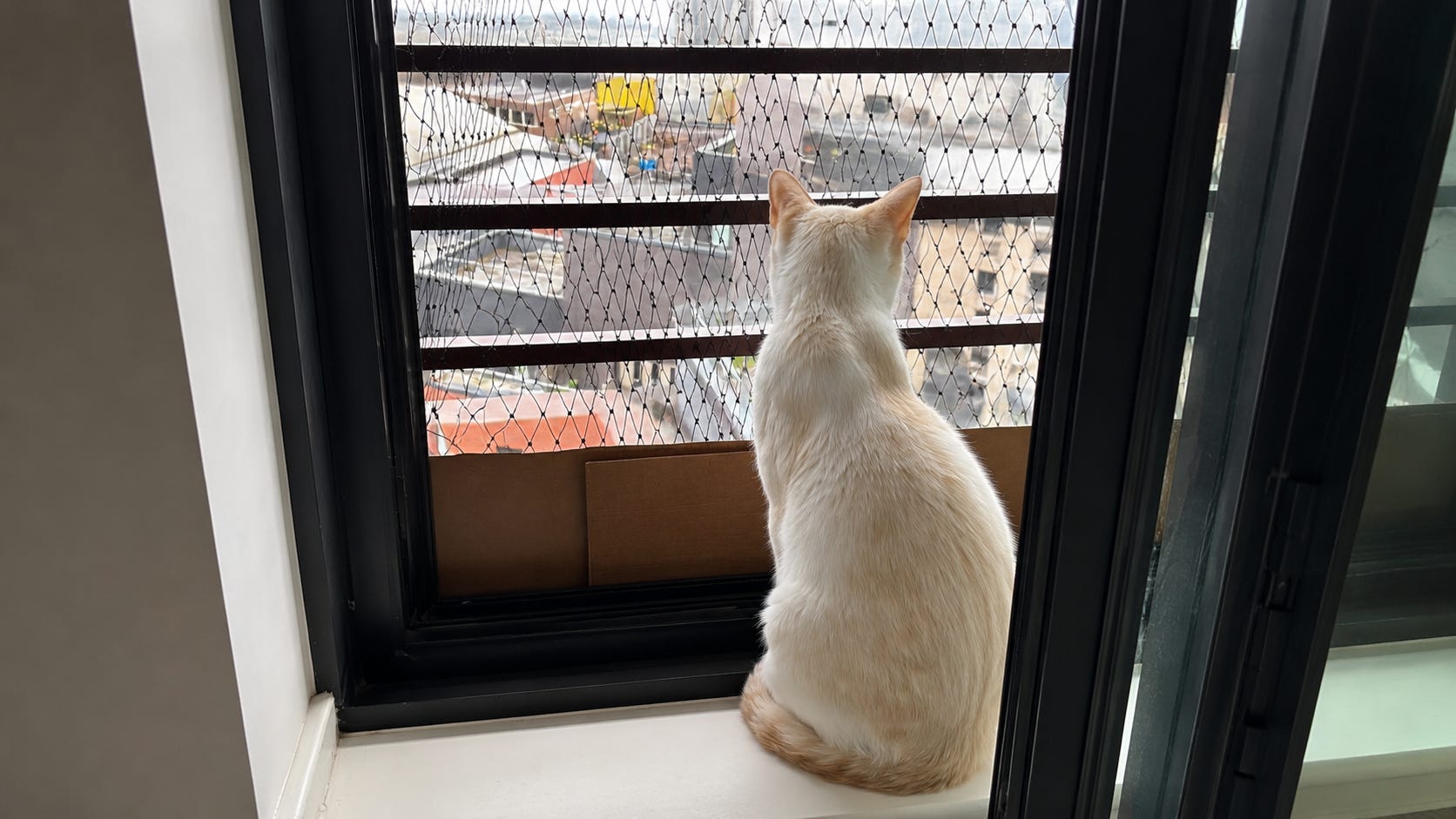
Her name is Minnie. She is very still. Very focused. Watching and sniffing the air of her new environment through a mesh we installed hastily after realising that a cat with no concept of twelve floors and a great deal of personal confidence was going to nose-dive into Cardiff. On the other side of the mesh, a pair of seagulls are nesting on a rooftop below, their fluffy chick having just arrived into the world, all of it entirely new to her. Minnie watches with the absolute, unhurried attention of a cat who has decided that if she can’t be out there, she’ll at least be completely present to what’s in front of her.
I find her quietly instructive.
She’s not, as far as I can tell, composing a strongly worded letter to the management about the mesh. She’s not scrolling her phone to see if things are better elsewhere. She’s simply reading her world with her whole body, right now.
I have been trying to do the same. With, I’ll admit, considerably less grace than Minnie.
The alarm that went off before you heard it
Here’s something I’ve come to believe, and it took me longer to arrive at than I’d like to admit.
At its heart, stress is not an emotional problem.
Having spent years in the personal and professional development world, I’ve experienced and shared many practices designed to bring us back to ourselves, journalling, breath-work, gratitude lists. I’ve sat in circles where we talked about our feelings with great sincerity and really excellent herbal tea. And of course, all of that matters.
But somewhere along the way, we seem to have collectively decided that stress lives primarily in the mind. That if we could just think differently, reframe things, find the silver lining, we’d be absolutely fine.
Meanwhile, our bodies are sitting there going: “excuse me, hello. We’ve been trying to get your attention for some time…”
Because before you have named it, before you’ve told anyone, before you’ve even consciously registered that something is wrong, your body already knows. Your nervous system has clocked the threat, real or perceived, and has begun its ancient and extraordinarily efficient response.
We’ve spoken of this before. Heart rate rises. Breathing becomes shallower. Muscles brace subtly. Digestion is quietly deprioritised because when something is chasing you, lunch can wait.
This is not a flaw in the design. This is the design.
The body’s stress response is one of the most elegant pieces of biological engineering there is. It has kept human beings alive through things that would make your current inbox look fairly manageable.
The problem isn’t the alarm. The problem is that most of us have never been taught to hear it, to actually feel it, before we’re already deep in the emergency.
What the mind does instead
The mind is a storyteller. It takes the raw physical data, the tightness, the shallow breath, the braced shoulders, and builds its own narrative. It finds reasons, connects dots, and constructs, with impressive speed and considerable creativity, an explanation for why you feel the way you feel.
Sometimes it’s right. But sometimes it’s doing what storytellers do, embellishing, catastrophising, following a thread long past the point where it was useful.
I noticed this very clearly during my own upheaval that I wrote about last time, the truck lost somewhere in Portugal, the boxes in transit, the not-knowing. My body had registered something was wrong long before I had a clear story about exactly what. There was a tightness, a low-level bracing in my whole physical self. My mind, meanwhile, was running scenarios at speed, constructing ever more elaborate versions of how this might unfold.
My body was sending a signal. My mind was writing a drama.
This is the gap that costs us. Not the physical signal, that’s just honest information. But the space between the signal and our awareness of it, in which the mind has already sprinted ahead and built an entire production we’re now performing all the parts of.
You’ve been there. We all have. That particular confusion of not knowing whether you’re anxious about the actual thing, or about the seventeen things that have attached themselves to it since Tuesday.
Learning to read the room
What changes everything is learning to catch the signal earlier. To feel the physical ‘something is off’ before the mind has had time to construct one of its stories.
Not to suppress the story or to bypass the feeling. But to arrive before the narrative does.
When I started paying closer attention to this in my own life, I noticed something both obvious and startling. My body had an opinion about almost everything, long before my thinking mind did. A tightening in my chest before a conversation I was dreading. A kind of deflation in my whole physical being before I’d consciously registered disappointment. A restlessness, a barely-there sense of something-isn’t-right, days before I could have told you what wasn’t right.
The body is not lagging behind. It’s running ahead, sending dispatches, and patiently waiting for us to open the messages.
Alignment, and the lack of it
In Buddhism there’s an understanding, quiet but insistent, that we exist in an ongoing relationship between our inner and outer worlds. When those worlds are in alignment, when our actions reflect something true in us, when our environment and relationships match our actual values rather than the ones we think we should have, there is a deep quality to that. A kind of ease. Not the absence of difficulty or challenge, but a sense of being in kilter.
And when we’re out of alignment? The body knows that too.
Not always loudly. Often, it’s that sense of unease I mentioned a few weeks ago. A kind of flatness. A sense of going through the motions. A vague, formless restlessness that no amount of scrolling quite resolves.
That’s not an emotional response to nothing. That’s the body’s quiet, persistent signal that something somewhere is out of true. And it’s worth learning to hear it as information, early, before it has to get louder to be noticed.
A small act of tending for this week
Once a day, morning is good, but whenever you can, before you check anything digital, before the day’s narrative revs up, take sixty seconds for a quiet physical inventory.
Not an assessment. Not a list of what’s wrong. Just a gentle scan.
Where am I holding tension right now?
What’s the quality of my breath — shallow, held, easy?
Is there anywhere in my body that feels braced, guarded, or simply heavy?
You’re not trying to fix anything. You’re just reading the room.
Arriving before the story does and giving the signal a chance to be heard before it has to get louder.
Minnie, observing her world from the twelfth floor, seems to have this entirely figured out. She is not troubled by the mesh, or the drop, or the seagulls she cannot reach. She is simply here, present, attending with her whole unhurried self.
I’m working on it.
Winter always turns to spring. It always has. And it always will.
With love, Kathy ❤️
Love this Kathy. The body does more than keep score. It's a sensitive instrument taking readings every moment responding,signalling, safety, alignment, presence. Or not. Cat's are brilliant at being present, taking life in,and just being. No mental special effects system doing overtime. Definitely the time to be more cat.
Love this Kathy. The body does more than keep score. It's a sensitive instrument taking readings every moment responding,signalling, safety, alignment, presence. Or not. Cat's are brilliant at being present, taking life in,and just being. No mental special effects system doing overtime. Definitely the time to be more cat.